
Senior Cycle
The Senior Cycle curriculum is undergoing a major national transformation designed to provide a more inclusive, modern, and flexible educational experience for students. The Senior Cycle Redevelopment program shifts the focus toward continuous learning, critical thinking, and practical skills, preparing students for post-secondary education, apprenticeships, and the modern workplace.
The redevelopment is built on three main pillars designed to prepare students for life after school:
- Empowering Students: Equipping young people with the key competencies, skills, and values needed to meet the challenges of the 21st century.
- Enriching the Experience: Building on the strengths of our current system while introducing more variety and flexibility in how students learn.
- Embedding Wellbeing: Assessment moments will be spread out, with a move away from a single, high-stakes final exam.
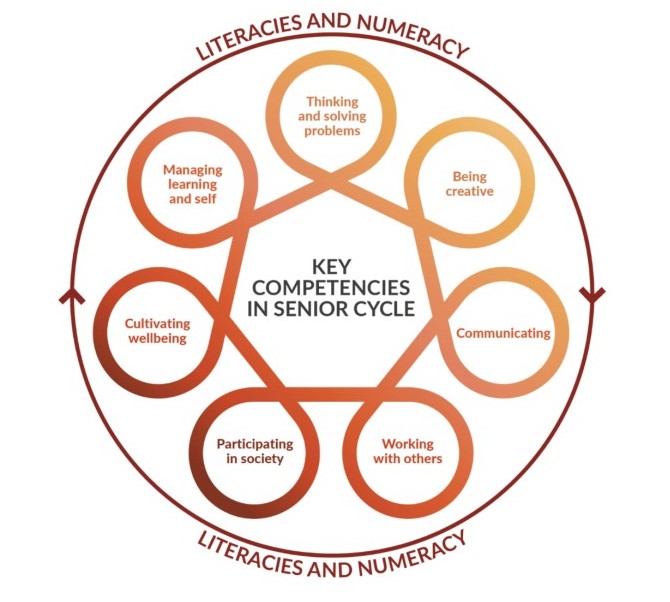
Key Competencies in Senior Cycle
As illustrated in the NCCA diagram above, the redevelopment centers around seven interconnected Key Competencies framed by Literacies and Numeracy:
- Thinking and solving problems
- Being creative
- Communicating
- Working with others
- Participating in society
- Cultivating wellbeing
- Managing learning and self
These competencies ensure that learning goes beyond memorising content, equipping students with transferable skills for higher education and modern careers.
WHAT ARE ADDITIONAL ASSESSMENT COMPONENTS (AACs)?
To reduce reliance on a single set of final June written examinations, the redeveloped curriculum introduces Additional Assessment Components (AACs) across all revised subjects.
- Practical & Varied Assessment: AACs encompass non-traditional, practical assessments such as research projects, laboratory investigations, oral tests, portfolios, or practical performances.
- Significant Weighting: AACs account for a minimum of 40% of total marks in a subject, leaving the final written examination to account for the remaining percentage.
- External Marking: While completed during class time under teacher supervision and guidance, AACs are externally marked by the State Examinations Commission (SEC) to maintain national standardisation and fairness.
Rollout of Subjects:
Revised subjects are being introduced in “tranches” every year. By 2029, every subject in the Leaving Certificate will have been updated.
- Tranche 1 Examinable 2027: Biology, Business, Chemistry, Physics
- Tranche 2 Examinable 2028: Geography, Physical Education
- Tranche 3 Examinable 2029: English, History, Mathematics, Music, Agricultural Science, Home Economics, Design and Communication Graphics
- Tranche 4 Examinable 2030: Art, Economics, French, Gaeilge, German, Politics and Society
What This Means for Students and Parents
For Students:
- More Choice: Multi-modal assessment – both written and continuous assessment projects – Additional Assessment Components (AACs) in all subjects* – by 2029
- Reduced Pressure: With 40% of your marks earned through projects or practical work before June, the final exam becomes less stressful.
- Support for All: New Level 1 and Level 2 Learning Programmes provide personalised certificates for students with particular additional educational needs.
For Parents:
- Clearer Learning Goals: New “scaffolded” learning outcomes make it easier to see exactly what your child is expected to know and be able to do.
- Modern Skills: The focus on “Key Competencies” ensures your child is developing the critical thinking, creativity, and communication skills required for modern careers.
We are committed to supporting our students through these changes. For more detailed information on specific subject specifications, you can visit curriculumonline.ie.